15/06/2022
Dr. Marcos J Gomes Sarmento
Cirurgião Dentista
CRO-PE 19681

CRO-PE 0119681
Abstract
Skin aging is a multifaceted process influenced by both intrinsic factors, such as collagen degradation and decreased elasticity, and extrinsic factors, including excessive sun exposure, pollution, and poor lifestyle choices. Although aging is inevitable, its visible effects can be significantly mitigated through modern aesthetic interventions. Facial harmonization techniques, such as hyaluronic acid fillers, botulinum toxin, and collagen biostimulators, have become prominent for their minimally invasive nature and shorter recovery times compared to traditional plastic surgery. Research, including studies by Martins et al. (2023) and Matthews-Brzozowska et al. (2019), underscores the efficacy of these treatments in improving aesthetics, enhancing self-esteem, and achieving noticeable results. Hyaluronic acid fillers are noted for their ability to restore volume and reduce wrinkles, while CGF Harmony has shown promise in stimulating cellular regeneration and improving skin elasticity. Despite these advancements, personalized treatment remains crucial, as each patient experiences a unique aging process. Therefore, individualized evaluations are necessary to ensure natural results and effective maintenance. Furthermore, the need for more robust scientific evidence is evident. While early studies are promising, such as those on hyaluronic acid and NMES, there is still a lack of conclusive clinical data. As highlighted in the study by Consulin, Vasques, and Leonardi (2023), NMES shows theoretical potential but requires further investigation to confirm its efficacy in facial rejuvenation. The future of aesthetic treatments for skin aging looks promising, with ongoing developments in technology and less invasive methods. However, achieving optimal results will depend on continued scientific research, ensuring high-quality studies, and addressing methodological limitations to improve treatment efficacy and patient safety.
Keywords: Skin aging; Facial harmonization; Hyaluronic acid fillers; CGF Harmony; Neuromuscular Electrical Stimulation (NMES).
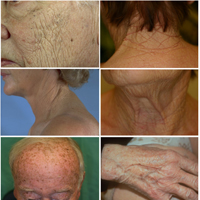
The aging process, while natural and multifactorial, brings about noticeable changes in the skin, particularly in the dermal and subcutaneous layers, leading to volume loss, wrinkles, and sagging. Over time, collagen and elastin degrade, cellular regeneration slows, and subcutaneous fat redistributes, all of which contribute to an aged appearance. External factors like sun exposure, pollution, and lifestyle choices further exacerbate these signs. A key early indicator of aging is the loss of facial volume, especially in the cheeks, jawline, and temples, which is often accompanied by the formation of wrinkles and skin laxity.

Figure 1: Changes because facial aging.
Source: Hudson, Brissett and Carniol (2021).
To combat these effects, facial harmonization procedures have gained popularity, offering minimally invasive solutions that restore volume, smooth wrinkles, and enhance skin firmness. Among the most common treatments is hyaluronic acid, a naturally occurring substance in the skin, which helps restore lost volume and reduce the appearance of deep wrinkles. Beyond its volumizing effect, hyaluronic acid also improves skin hydration and radiance. Another widely used approach is the application of botulinum toxin, commonly known as Botox, which temporarily relaxes facial muscles responsible for dynamic wrinkles, such as those around the forehead and eyes. When used preventively, Botox can delay the onset of static wrinkles, contributing to a more youthful appearance over time.
Collagen bio-stimulators like calcium hydroxyapatite and poly-L-lactic acid have also demonstrated effectiveness in promoting the skin’s natural collagen production, which aids in restoring firmness and elasticity. These treatments are particularly beneficial in addressing sagging skin, offering long-term rejuvenation. Additionally, thread lifts are employed to lift sagging skin, providing an immediate tightening effect while simultaneously stimulating collagen production in the treated areas. Over time, this combination of techniques results in a firmer and more structured facial appearance.
While facial harmonization procedures cannot halt the aging process, they offer an effective means of minimizing its visible signs. By restoring volume, reducing wrinkles, and addressing skin laxity, patients can maintain a youthful and balanced appearance. The success of these treatments relies on individualized assessments and consistent maintenance to ensure long-lasting and natural results.
Studies have emphasized the importance of early intervention in facial aging. For instance, research by Matthews-Brzozowska et al. (2019) highlighted the benefits of using autologous preparations like CGF Harmony, derived from the patient’s blood, to combat skin aging. The study demonstrated significant improvements in skin elasticity and facial contour after three applications, particularly in patients over 40, suggesting the need for regular monitoring and potential combination treatments for optimal results.
Similarly, Martins et al. (2023) explored the use of hyaluronic acid to address perioral aging, a critical area affecting both aesthetics and self-esteem. The findings indicate that hyaluronic acid effectively improves the lower third of the face, enhancing facial appearance, boosting self-confidence, and improving quality of life. Despite these positive outcomes, the study pointed out methodological limitations in existing research, calling for higher-quality studies in the future.
Another area of interest is the potential of Neuromuscular Electrical Stimulation (NMES) in reducing signs of facial aging. Consulin, Vasques, and Leonardi (2023) reviewed the limited literature on NMES, recognizing its theoretical promise in improving skin appearance by stimulating facial muscles. However, the lack of conclusive clinical evidence underscores the need for further research to validate NMES’s effectiveness in facial rejuvenation and its interaction with the skin’s physiological mechanisms.
In conclusion, skin aging is a complex and multifactorial process, involving both intrinsic factors, such as collagen degradation and loss of elasticity, and extrinsic factors, such as excessive sun exposure, pollution, and inadequate lifestyle habits. While aging is inevitable, its manifestation can be significantly delayed and its effects mitigated through aesthetic interventions that have become increasingly accessible and effective.
Facial harmonization procedures, such as hyaluronic acid fillers, botulinum toxin application, and collagen biostimulators, have revolutionized aesthetic approaches by offering less invasive solutions with shorter recovery times compared to traditional plastic surgery. Studies like that of Martins et al. (2023) highlight the effectiveness of hyaluronic acid fillers in improving the aesthetics of the perioral region, contributing to increased self-esteem and patient satisfaction, especially by softening the signs of aging in the lower face. Similarly, the research by Matthews-Brzozowska et al. (2019) demonstrated the benefits of autologous preparations, such as CGF Harmony, in stimulating cellular regeneration and improving skin elasticity, with long-lasting and noticeable results.
However, despite advancements in aesthetic techniques, studies emphasize the importance of personalized treatments. Each patient presents a unique aging process, which requires careful and individualized evaluation to ensure natural and harmonious results. Furthermore, regular maintenance of treatments is essential to prolong the achieved benefits, as the effects of many of these procedures are temporary.
Another important point to consider is the need for more studies with greater methodological rigor. Although initial evidence on the effects of procedures like hyaluronic acid and biostimulators is promising, many studies still lack scientific robustness, as noted by Martins et al. (2023), which limits the generalization of the results. Additionally, new therapeutic approaches, such as Neuromuscular Electrical Stimulation (NMES), are still in preliminary stages of investigation. Despite its theoretical potential in facial rejuvenation, as explored in the study by Consulin, Vasques, and Leonardi (2023), there is a lack of concrete clinical evidence to prove its effectiveness. This underscores the need for further research to more precisely analyze the physiological mechanisms involved and their long-term aesthetic repercussions.
Therefore, the future of aesthetic interventions in combating skin aging appears promising, with the continuous development of more refined and less invasive technologies and methods. However, for these procedures to reach their full potential, it is essential for scientific research to continue advancing, promoting high-quality studies with low bias and greater reproducibility. This will not only improve the efficacy of treatments but also ensure the safety and well-being of patients seeking to maintain a younger and healthier appearance.
References
15/06/2022
Consulin, M., Vasques, L., & Leonardi, G. (2023). Neuromuscular Electrical Stimulation in Facial Aging: an Integrative Literature Review. Fisioterapia e Pesquisa, 30. https://doi.org/10.1590/1809-2950/e21008423en.
Hudson, C., Brissett, A., & Carniol, P. (2021). Analysis and Assessment of Facial Aging. Current Otorhinolaryngology Reports, 1-7.
Martins, H., Carpinteiro, I., Mascarenhas, P., Goes, M., & Oliveira, H. (2023). Hyaluronic Acid as a Mechanism to Mitigate the Effects of Face Lower Third Aging in Dentistry: A Review. Applied Sciences. https://doi.org/10.3390/app13158657.
Maso, A., & Tramontini, L. (2023). The benefits of nanostructured transdermal hormonal replacement therapy in orofacial harmozization treatment. Health and Society. https://doi.org/10.51249/hs.v3i03.1405.
Matthews‑Brzozowska, T., Łącka, M., Mojs, E., & Kubisz, L. (2019). Analysis of the facial skin condition of a mature person before and after CGF Harmony. Journal of Face Aesthetics. https://doi.org/10.20883/jofa.9.
Matthews‑Brzozowska, T., Matthews‑Kozanecka, M., Krzyżanowska‑Lula, A., Kawałkiewicz, W., & Hojan‑Jezierska, D. (2018). CGF Harmony facial skin revitalization for a 40+ patient. Journal of Face Aesthetics. https://doi.org/10.20883/jofa.1.
Swift, A., Liew, S., Weinkle, S., Garcia, J., & Silberberg, M. (2020). The Facial Aging Process From the “Inside Out”. Aesthetic Surgery Journal, 41, 1107 – 1119. https://doi.org/10.1093/asj/sjaa339.